There is one question that every human being must eventually confront: What happens when we die? Regardless of our education, financial circumstances, accomplishments, religious background, or personal philosophy, death is an unavoidable reality of human existence. Some people believe death is simply the end of consciousness, while others believe in reincarnation, an impersonal spiritual existence, or some form of life beyond the grave. Christianity offers a distinct answer. It teaches that physical death is not the end of human existence and that every person will ultimately stand before God. Our understanding of eternity is therefore one of the most important elements of any worldview.
The Bible teaches that death entered human experience through sin. Genesis 2:16–17 records God’s warning concerning disobedience, and Romans 5:12 explains that sin entered the world through one man and death through sin. Death is not presented in Scripture as humanity’s natural and harmless conclusion. It is an enemy connected to the brokenness introduced through the fall. Yet Scripture also teaches that physical death does not eliminate our accountability to God. Hebrews 9:27 states that it is appointed for man to die once, and after that comes judgment. Our lives are not meaningless events that disappear into nothingness. We are created beings who will ultimately answer to our Creator.
The Christian understanding of death also includes an important distinction between the intermediate state and the final resurrection. Scripture teaches that believers who die are with Christ, while their bodies await resurrection. Paul expresses his desire to depart and be with Christ in Philippians 1:23. In 2 Corinthians 5:8, he speaks of being away from the body and at home with the Lord. However, the ultimate Christian hope is not merely the continuation of the soul in heaven. It is the resurrection of the body and the restoration of creation. First Corinthians 15 explains that Christ’s resurrection is the foundation and guarantee of the future resurrection of those who belong to Him.
This is where Christianity stands apart from explanations that view death as the final end of existence. The resurrection of Jesus Christ is central to the Christian faith. Paul makes this unmistakably clear in 1 Corinthians 15:14 when he explains that if Christ has not been raised, Christian preaching and faith are empty. Christianity does not rest solely upon moral teachings, religious traditions, or philosophical ideas. It rests upon the historical claim that Jesus Christ died for our sins, was buried, and was raised from the dead. His resurrection demonstrates His victory over sin and death and provides the foundation for the believer’s future hope.
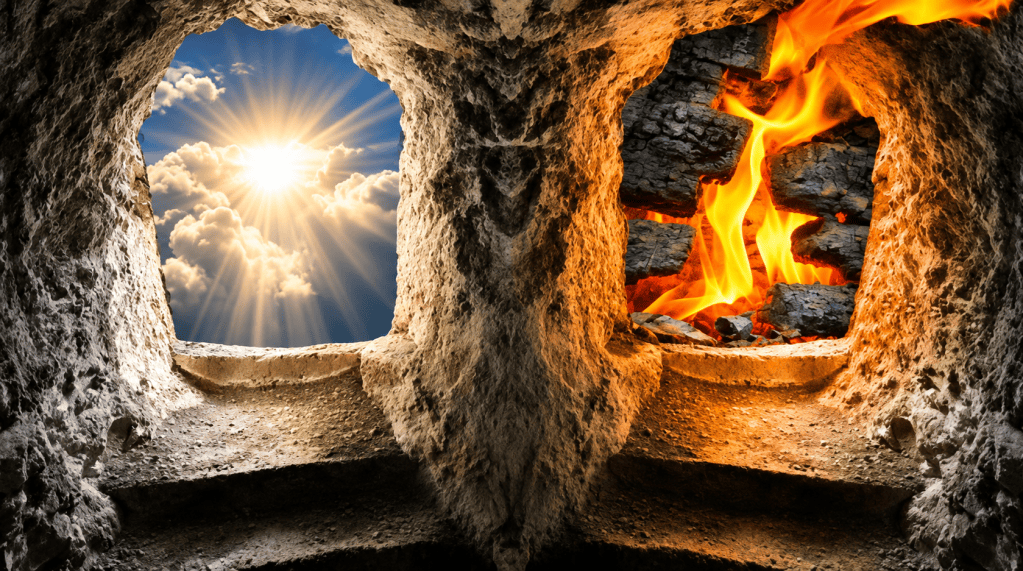
The biblical worldview also teaches that eternity involves judgment. Scripture presents two ultimate destinies: eternal life with God and eternal separation from Him. Revelation 20 describes the final judgment, while Revelation 21–22 describes the new heaven and new earth, where God dwells with His people and death, mourning, crying, and pain are no more. These teachings are not intended merely to satisfy our curiosity about the future. They remind us that our present lives have eternal significance. Our response to Jesus Christ matters because He is not simply another religious teacher. He is the Savior and Lord through whom God has provided reconciliation.
Timothy Keller’s Hope in Times of Fear is particularly helpful in understanding the significance of the resurrection for everyday Christian life. Keller explores how Christ’s victory over death provides hope in the midst of suffering, uncertainty, and fear. Wayne Grudem’s Systematic Theology provides a more detailed examination of death, the intermediate state, the resurrection, and final judgment. John Stott’s The Cross of Christ helps explain why the death of Jesus was necessary for our redemption. Together, these resources help us understand that the Christian hope is not wishful thinking or an attempt to avoid the reality of death. It is grounded in the finished work and resurrection of Jesus Christ.
The question we must ask is not simply what we believe happens when we die, but whether our beliefs are grounded in truth. Every worldview must eventually confront the reality of death, but not every worldview provides the same explanation or hope. Christianity acknowledges the seriousness of sin, the certainty of death, and the reality of judgment while proclaiming that Jesus Christ has conquered the grave. For the believer, death is not the final chapter. It is the passage into the presence of Christ while awaiting the promised resurrection. Our hope is not that we have lived good enough lives to deserve eternity. Our hope is that Jesus Christ has accomplished what we could never accomplish for ourselves.
Works Cited
Grudem, Wayne A. Systematic Theology: An Introduction to Biblical Doctrine. 2nd ed., Zondervan Academic, 2020.
Keller, Timothy. Hope in Times of Fear: The Resurrection and the Meaning of Easter. Viking, 2021.
Stott, John R. W. The Cross of Christ. InterVarsity Press, 1986.


Leave a Reply